●Product · Elenqora
The forensic workstation for SEC filings
Elenqora opens a company's filings, financials and public records in one workspace and reads them by itself. It places each accounting signal against similar-sized peers, flags the sentences worth a second read, raises leads with their innocent explanations attached, and keeps the case file as you work. Every number on screen links back to the filing it came from.
In development · sign-in required1:1
Every figure links to its filing: XBRL concept, section and accession.
PIT
Point-in-time peers: only filers public at that filing's date, same industry and size band.
Δ
As filed vs restated: what the company first reported and what later filings changed.
31
Regulator and public-record connectors beyond the filings (24 live).
Open a company. The reading runs by itself.
Nothing waits for a button. Each step shows a status line saying what is done and what is still waiting, with a small "now" link to run it early.
The filing list
The company's whole SEC filing list, checked again every day.
Every filing
Every filing of every year read into searchable text, newest year first. XBRL facts sync again after each new annual or quarterly report.
Insiders and builds
Forms 3, 4 and 5, then the builds: letters, governance, ownership, origins, revenue quality, the timeline, leads and filing flags.
Ready to read
Company home says how many filings are processed and shows the stored leads, flags and outside records.
01Risk
Indicators against peers, then the rank
LiveIndicators are computed from each company's own SEC XBRL filings. Each one stands on its own: its value, where it sits among peers in the same industry and size decile, and which direction is the concerning one. Each one opens to the filing and the XBRL concepts it was computed from. There is no combined score.
Below the indicators sits the Rank within size band (research): accounting signals compared with similar-sized companies, with the drivers that moved it. The rank covers 10-K filers; a company it does not cover shows the reason instead. How the rank is built →
- F-score variables flagged against peers, out of 7
- History across fiscal years and model runs
- Start a hypothesis or an evidence item from any driver
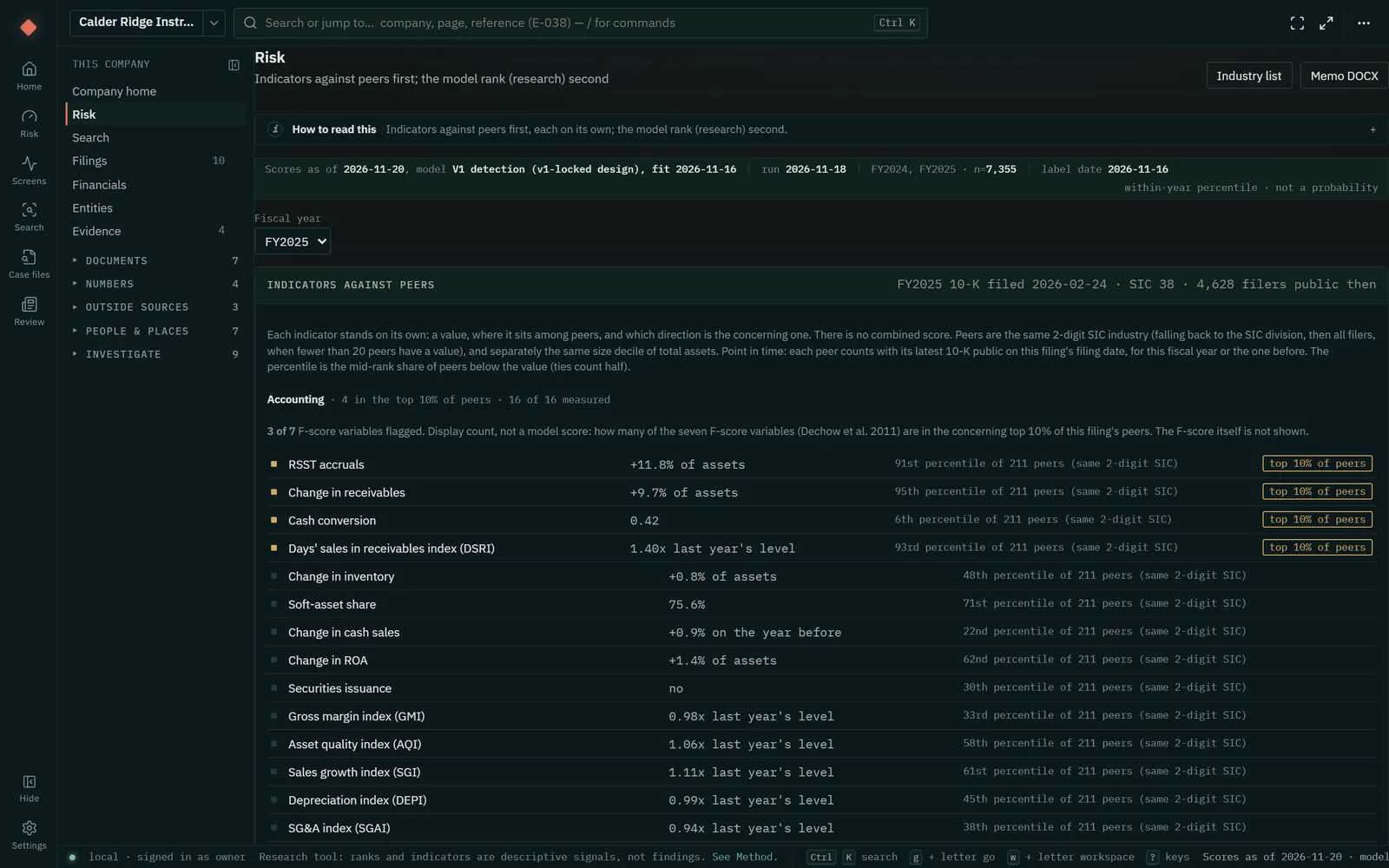
- 1Indicators against peers come first, each on its own.
- 2Flagged when the value sits in the concerning top 10% of industry peers.
02Lead Finder
Leads, with the innocent explanations attached
Live10 deterministic checks run over what is stored: CFO against net income, working-capital swings, profit concentration, margin jumps, write-down arithmetic, assumption changes, goodwill against value, SEC comment letters, regulator records and insider clusters.
Every lead says why it fired, lists the ordinary explanations to rule out first, and names the next thing to read. Where a filing flag checks the same thing, the lead shows a flags line counting the flags in its own source filings, and says which of them are not checked yet.
- The same checks run as a market screen across listed companies
- Saved screens combine ratio conditions, screen checks, 8-K items, leads and filing flags
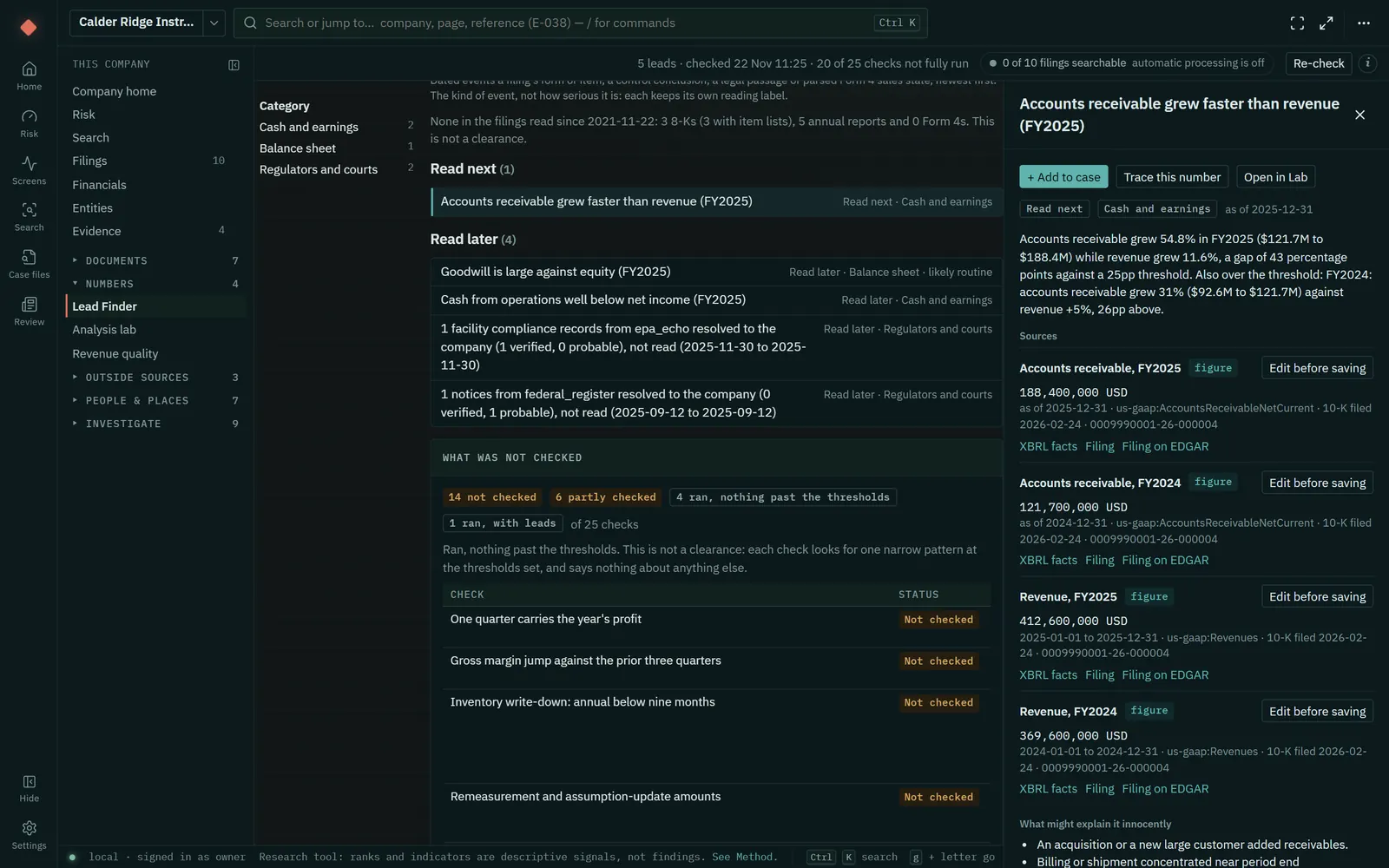
- 1Leads are a reading order: read next, read later.
- 2Every figure behind a lead cites its XBRL fact and filing; innocent explanations follow.
03Filing flags
The sentences worth a second read
Live218 rule checks in 20 areas, from revenue and receivables to internal control, departures and related parties, read every processed filing. 5 cross-checks go further: a figure stated in the text against the one computed from the stored figures, or a 10-Q's controls conclusion against the year's 10-K.
The reader highlights each flagged sentence by severity. Each flag gives its question, the words that fired, the rule in plain words, the innocent explanations, the next checks and the literature. Mark it reviewed or not an issue, or turn it into evidence.
- Flagged documents: high, medium and low counts side by side, never added together
- A filing superseded by an amendment says so, with a link
- Each check's precision on hand-checked hits is listed on the app's Method page
Management identified a material weakness in our internal control over financial reporting related to the timing of revenue recognition on distributor shipments.
HighIC-001 · v2 · internal control
Does the filing report a material weakness in internal control?
What might explain it innocently
- Small and newly listed companies often report a weakness over staffing or segregation of duties that has no effect on reported figures.
- A weakness may concern a single system migration or a newly acquired subsidiary and be remediated within the year.
Next checks
- Read the description: which account or process does the weakness concern, and was any figure adjusted?
- Compare with the auditor's report and the earlier 10-Qs: were controls called effective in the same period?
+ EvidenceReviewedNot an issue
04Financials
Statements as filed, and as restated
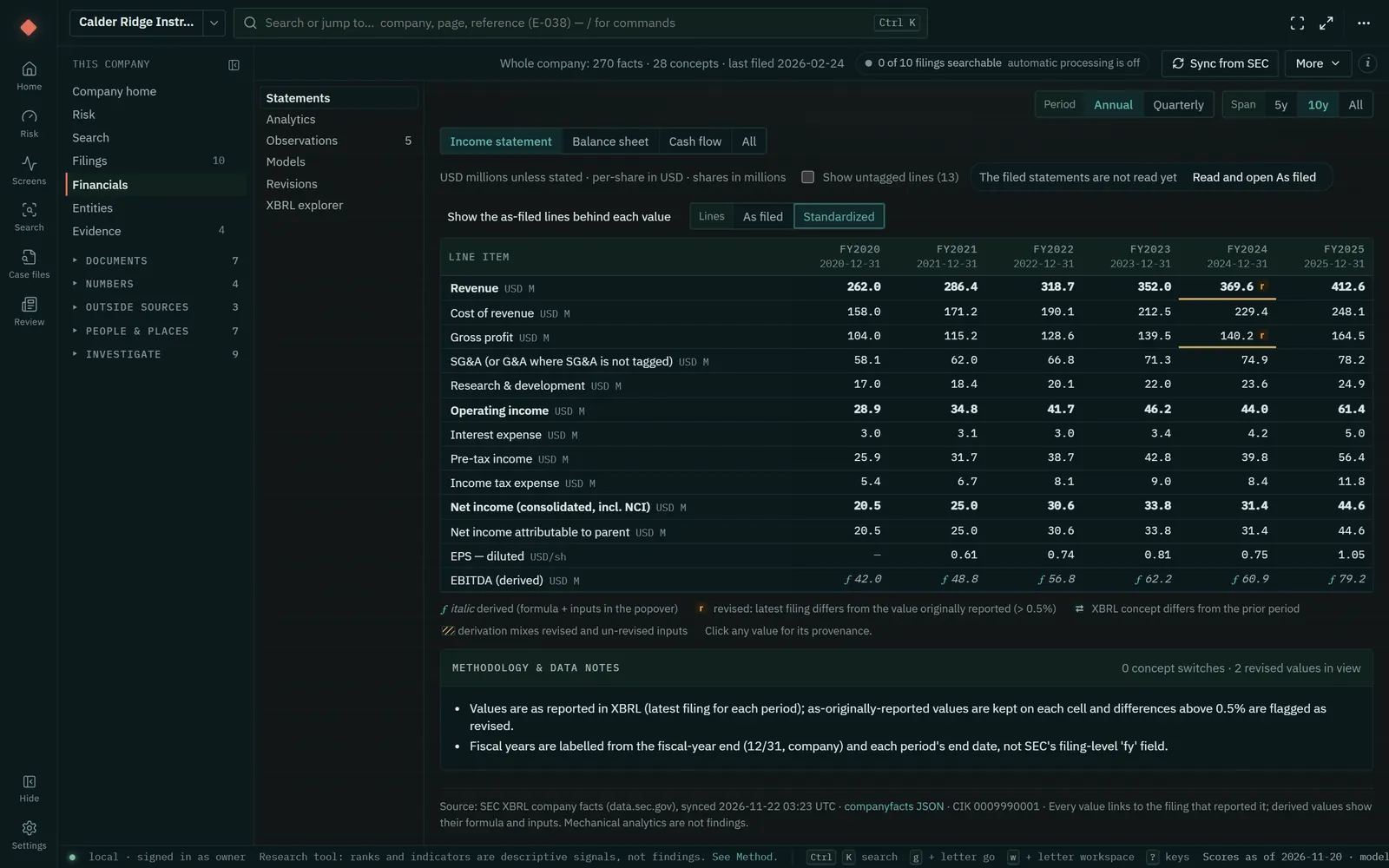
LiveRead the statements exactly as the company printed them, or on standardized lines, in the currency the company reports in. Switch between what was first filed and the latest recast. Every cell carries its XBRL concept and filing accession, and a trace follows a figure to where its trail ends.
- Revisions: what later filings changed, by class of change
- Analytics: margins, accruals, cash conversion, days sales outstanding
- XBRL explorer and SEC frames for peer comparison
05Regulators & courts
Public records, graded by how they tie to the company
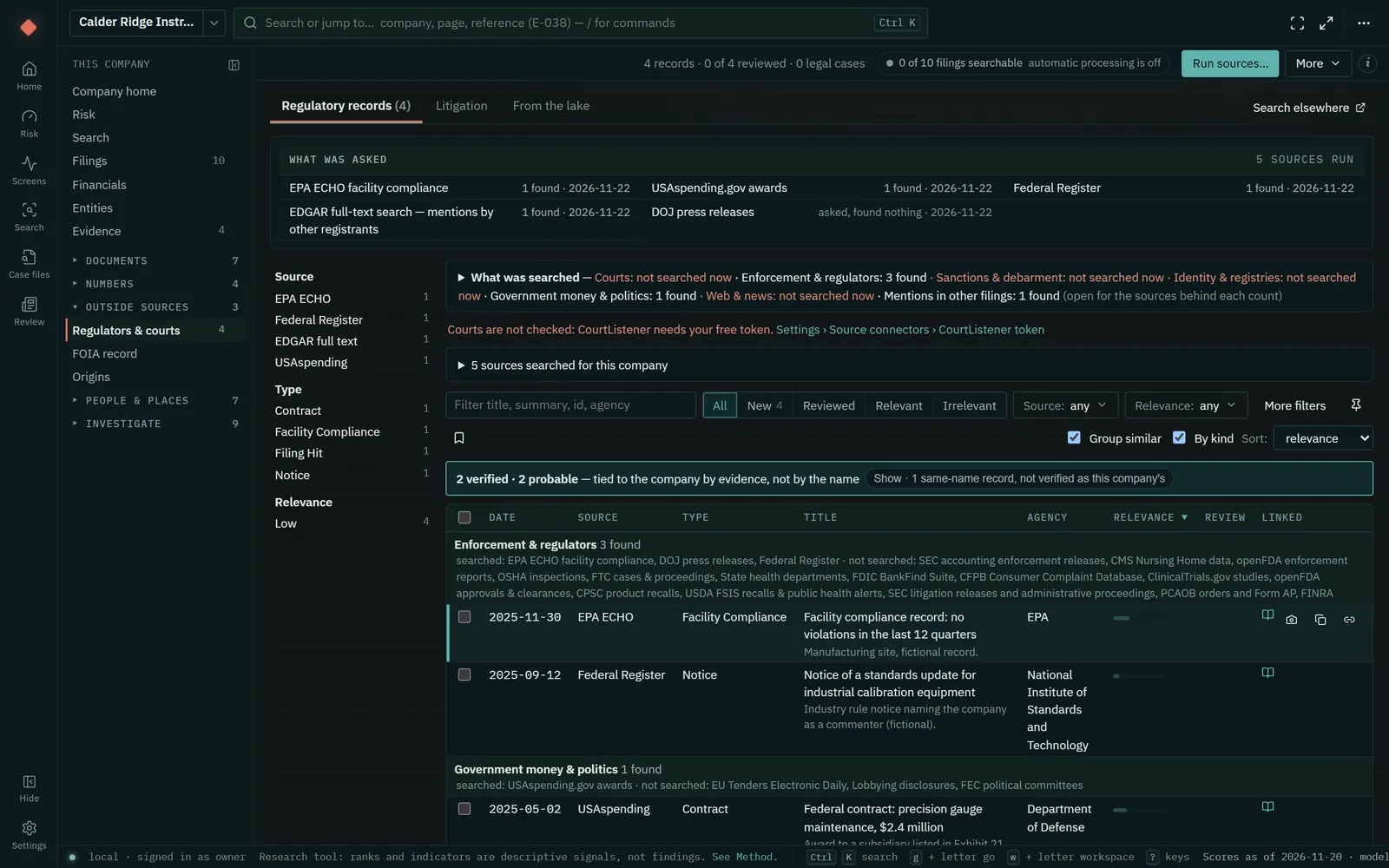
LiveRecords from 31 regulator and public-record connectors are stored with the source's own text and raw response. Each is graded by how closely it ties to the company: the same company, a subsidiary, or not this company.
Courts across the corporate family list the dockets that name the company or a member of its family, and check each against the 10-K's Legal Proceedings section: mentioned, not found, or not checkable. A party that only shares a name stays apart, marked "same name, not confirmed".
Family, FOIA logs, addresses and the website
Built across the companies in the screen and read on Company home. A source not asked yet says "not checked yet", never zero.
Links, never merged
Parents, subsidiaries, owners, officers and related parties as separate entities, each link graded by the kind of evidence behind it.
What the FOIA logs record
Requests to agencies about the company from published FOIA logs: counts against its own history and its peers, exemption 7(A) withholdings and who asked. Descriptive indicators, not a forecast.
Who else is at this address
The class of each business and mailing address, with the votes behind it, and how many others are registered in the same suite or building.
The website the 10-K names
The domain the annual report gives, with its confidence and the sentence that names it, then registration, mail, hosting and first archive capture.
The same records can be followed outward from any registry number, website or address in Registry & web →
07Case files
Hypotheses, evidence and the trail between them
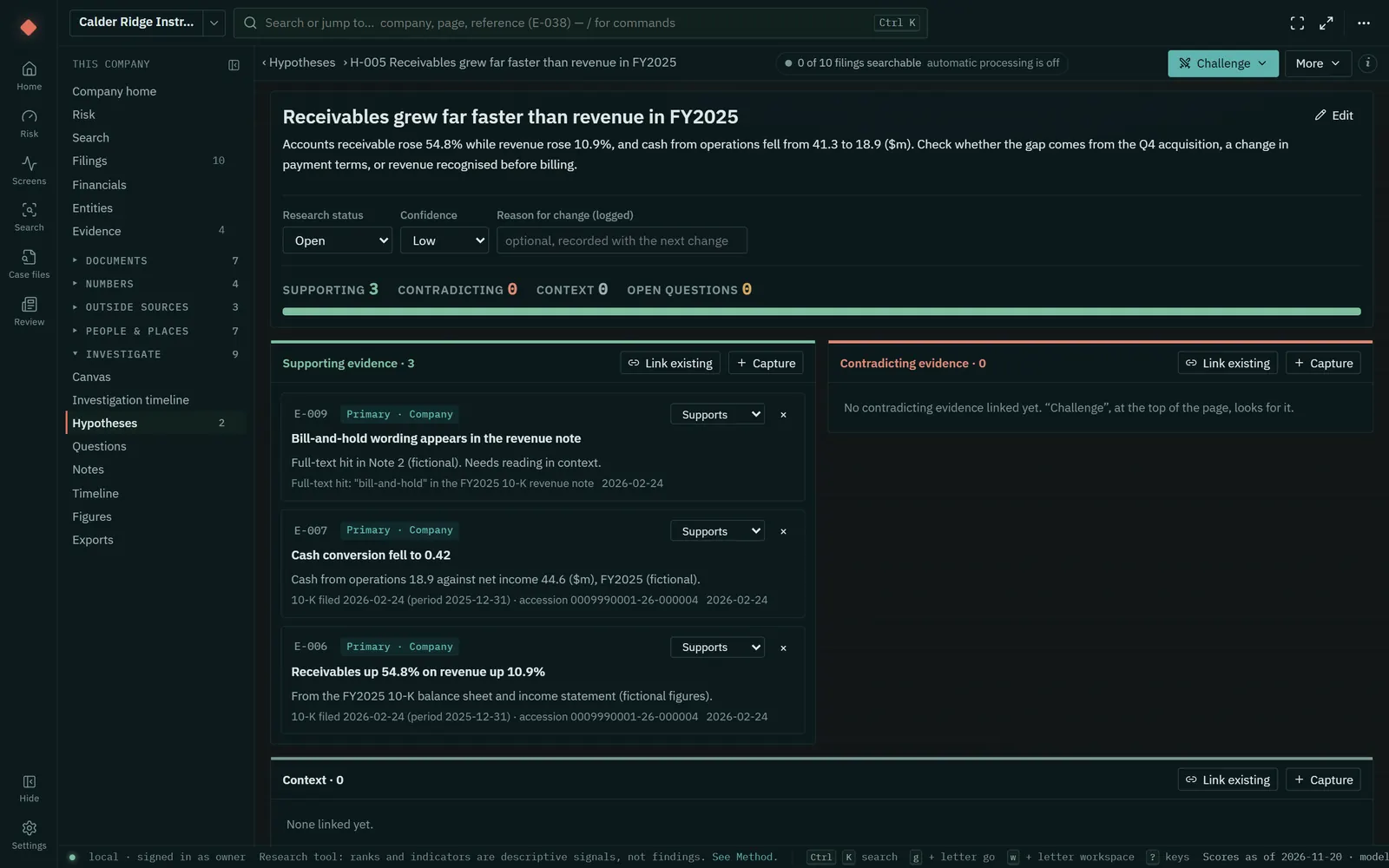
LiveWrite hypotheses, including the innocent ones, and link evidence for and against. Questions, notes, figures, a canvas, a relationship graph and an investigation timeline keep the case in one place. AI notes are kept apart from evidence.
08Exports
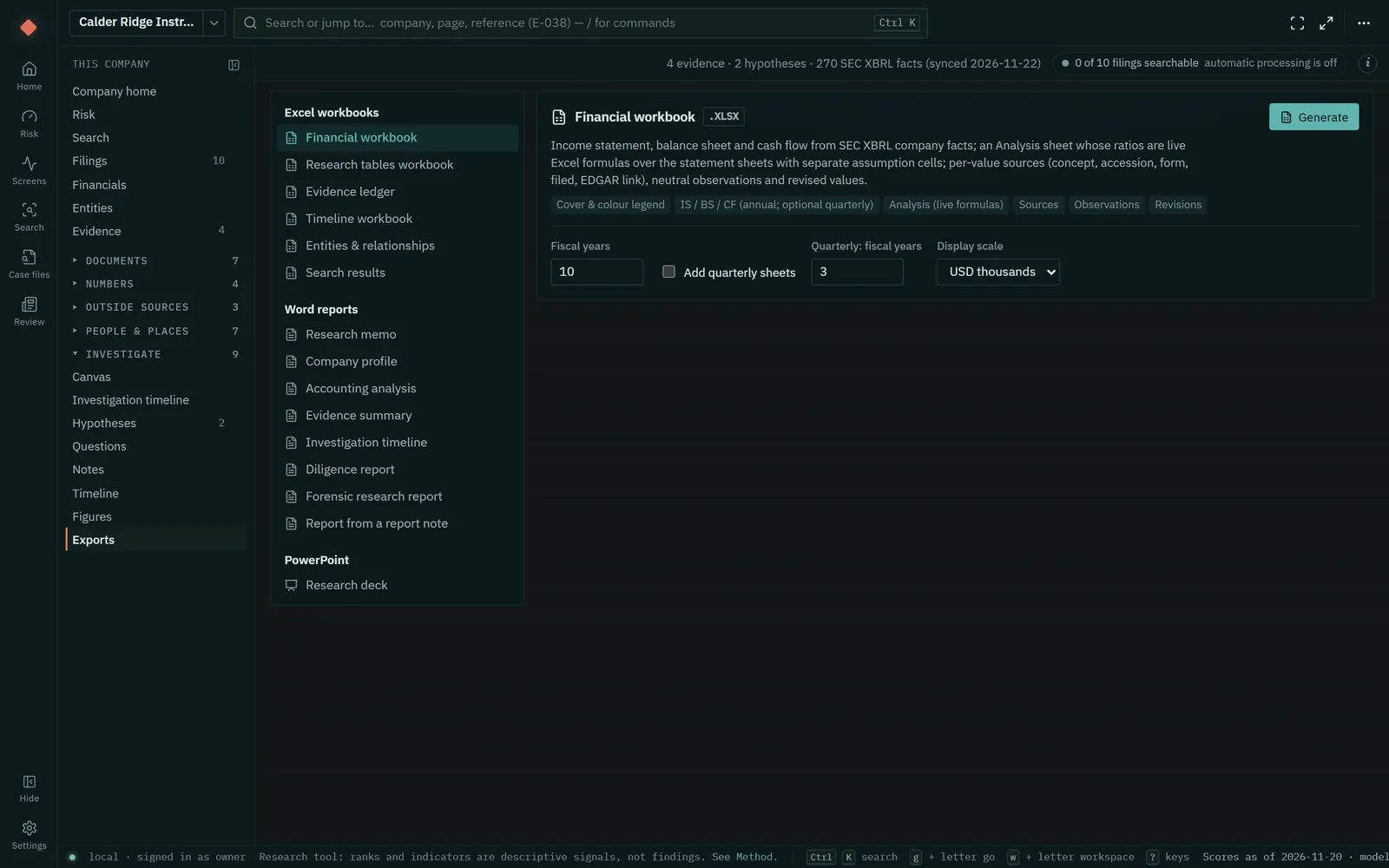
15 exports, each stamped as a research draft
Live6 Excel workbooks, 1 PowerPoint deck and 8 Word reports, from a financial workbook to a full research memo. Each export re-hashes its source files and carries a "Draft, for research purposes only" stamp.
Which companies, and what each one gets
8,116
Companies in the screen, each with its address check, corporate family and website card. Any SEC filer can be opened as a workspace.
10-K
Indicators against peers and the research rank cover companies that file a 10-K.
20-F
20-F and 40-F filings are read and flagged, and their statements stay in the currency the company reports in.
1,706
Financial companies, 640 of them banks: measures that do not apply to them, such as receivables and inventory, read "not used for banks" and never flag.
In developmentWhere it stands
The app, with sign-in
Elenqora runs at app.elenqora.com for signed-in researchers.
Shared workspaces
Several researchers on one case file.